
How-To Guides
Six recipes for the jobs you will actually do with Warren, from an honest market read to publishing a strategy. Each is a plain-English conversation, not a configuration exercise.
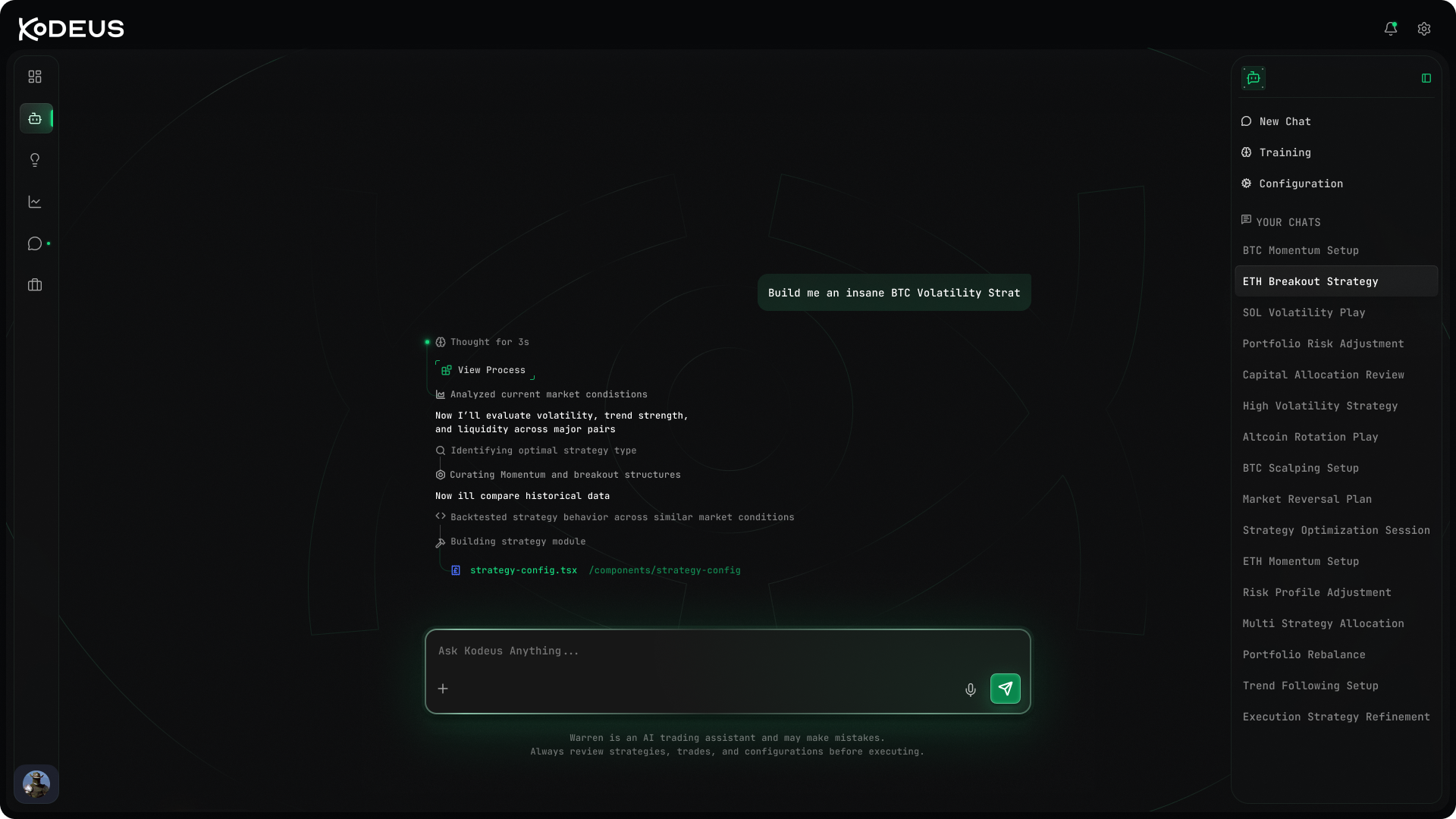
Everything below is driven by talking to Warren. You never call anything directly: you describe what you want, and Warren selects and chains the right capabilities behind a calibrated, honesty-gated answer.
1. Get an honest market read
Ask Warren: "What's BTC doing right now?"
You get back the regime, how strongly the timeframes agree, and the level that would prove the read wrong.
An abstention is a correct outcome, not a failure. A platform that answers anyway is guessing with your money.
2. Find and validate a strategy
Ask Warren: "Find me a low-risk strategy for this market."
Then insist on the full discipline before any capital is involved.
See Strategy Recommendations for discovery and Building and Backtesting for the honest testing discipline in full.
3. Deploy a paper bot with guardrails
Ask Warren: "Paper-trade it on BTC with a 5% profit target, 5% max loss, and stop after 20 trades."
Paper is the default and needs no exchange keys. See Trading Modes for how paper and live differ, and Dashboard Overview for the per-bot health verdict.
4. Let Warren trade a position
Ask Warren: "Open a small long on SOL with a stop-loss and take-profit."
This is Warren's own discretionary book, kept entirely separate from your strategy bots. See Capital Allocation for how the two share one capital pool without ever double-spending.
5. Watch the market while you're away
Ask Warren: "Check the market every morning and message me what changed."
Scheduled runs are watch-and-report by default: Warren is hard-blocked from trading on an unattended run. Arming autonomous execution is a separate, deliberate step, nothing ever trades unsupervised by accident.
6. Publish or vet a marketplace strategy
Ask Warren: "Publish this strategy to the marketplace" or "Is this strategy actually any good?"
A "+180%" card with one catastrophic regime is a disqualification, not a buy. Marketplace numbers are computed by the platform from verified backtests, never typed in by an author.
Continue
Dashboard Overview
Track every running strategy and read the per-bot health verdict.
FAQ
Why a bot stopped, why live and backtest results differ, and more.
Next: FAQ
Exchange Connectivity
Warren connects to seven venues through API-based authorization under a non-custodial model. Your funds stay on your exchange, your keys are encrypted to your identity, and leverage is capped in code.
Market Intelligence
Read any market with Warren: regime, indicators, prices, and news, all computed on closed candles and stamped with freshness.