
Overview
Warren is your private AI fund manager on Kodeus: discover a proven strategy, validate it honestly, deploy it, and monitor it, all through conversation.
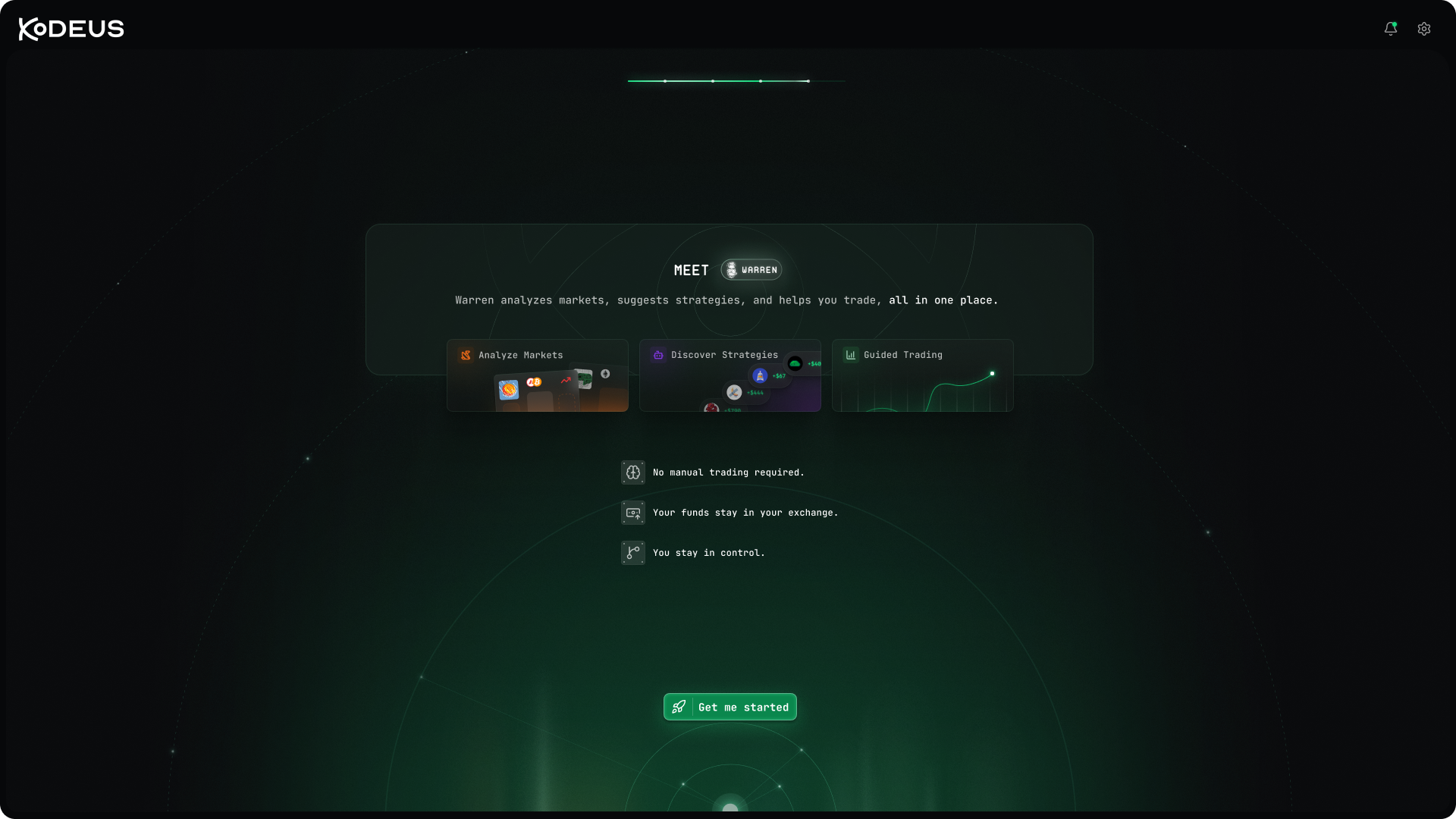
Warren is your private AI fund manager for crypto, powered by Kodeus. You talk to it in plain English, and it brings institutional-grade discipline within reach of any trader: discover a proven strategy, validate it honestly, deploy it, and monitor it with continuous checks, every claim verified before it reaches you.
Rather than replacing you, Warren does the work a disciplined fund manager does, and it earns that title by being calibrated and honest, not a fortune-teller. Directional price prediction in crypto is close to a coin flip. Warren's edge is being precise about the state of a market, disciplined about risk, and honest about uncertainty.
Your funds always stay on your own connected exchange. Warren only ever receives execution authorization through exchange API keys, and never takes custody of your capital.
What makes it different
- Regime-conditional by design. No single strategy wins in every market, so Warren classifies the market's state first and conditions every recommendation, test, and deployment on it. This is the argument of Why Regime.
- Engineered not to lie. Every performance number passes a validity layer that targets the specific ways backtests mislead: look-ahead, overfitting, wrong-regime testing, and unmodeled costs. See Built Not to Lie.
- Safety enforced in code. Abstaining on thin data, confirm-to-approve on money actions, and a default block on unattended trading are hard mechanisms, not prompt suggestions. See Architecture.
- A marketplace for strategies, not signals. You discover transparent, data-backed strategies with verified track records instead of chasing influencers and one-off calls, and creators turn trading expertise into a discoverable, reputation-building asset. See Marketplace.
What you can do
Read the market
Regime, indicators, prices, and news context for any pair, on closed candles, stamped with freshness.
Get signals and alerts
A continuous scan of hundreds of tokens, curated into typed signals with levels and a real, outcome-tracked hit rate.
Build and backtest
Find or build strategies, then test them per-regime and full-period with an overfit guard and failure diagnosis.
Execute and trade
Automated strategy bots plus Warren's discretionary book, on paper or real funds, across seven exchanges.
Track performance
Profit and loss, drawdown, win rate, trade history, and plain-language health verdicts per bot.
Share and discover
A community marketplace with verified track records, judged on worst drawdown, not the headline number.
Run it unattended
Scheduled autopilot: watch-and-report by default, autonomous execution only if deliberately armed.
Stay in control
Account defaults, exchange connections, and enforced risk limits: leverage caps, drawdown caps, loss-streak pauses.
And everything above is driven by conversation: live reasoning, planning, memory, and a knowledge base. See Talking to Warren below.
How Warren works
Talking to Warren
Every capability in these docs is driven by plain-English conversation; you never call anything directly. You talk, and Warren selects and chains the right capabilities and returns a calibrated, honesty-gated answer. The conversational layer adds:
- Live reasoning. Warren's steps stream as it works, and a turn can be cancelled mid-run.
- Planning. Multi-step requests can be broken into an explicit plan before any action is taken.
- Suggested follow-ups. Substantive answers end with a few next questions phrased in your voice.
- Memory. Conversation context and preferences persist; long chats are condensed automatically so context is not lost.
- Knowledge base. Questions can be answered over your uploaded documents via retrieval.
- Input normalization. Sloppy input is understood: "buy me btcusdt $10" resolves to the right pair and size.
- Private per user. Strategies, trades, balances, memory, and settings are scoped to you alone.
How to read these docs
- New to Warren? Read this page and Core Concepts, then skim the capability pages above for what it can do.
- Evaluating the methodology? The design philosophy is the heart of it: Why Regime, Why Regime-Based Backtesting, and Built Not to Lie.
- Getting hands-on? Start with the Quickstart, then Onboarding, the Dashboard, and the How-To Guides.
- Integrating or auditing? The engine internals: The Regime Engine, The Validity Layer, and Architecture.
On proprietary internals. These docs describe what each mechanism does and why, and name the published techniques used. The exact indicator sets, classifier weights and thresholds, validity cutoffs, and infrastructure identifiers are deliberately treated as a black box: inputs, behavior, outputs. The contract and guarantees are documented; the numbers that would let the system be reconstructed or gamed are not.
Next: Quickstart